

SCOTT WALTER 

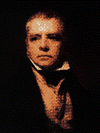 Sir Walter Scott (1771-1832)
Poet, novelist, and biographer.
Percy's Reliques of Ancient Poetry, pub. in 1765, came into his hands in 1784, and proved for him one of the most formative influences of this period. At 15 he was apprenticed to his flourished, but preferring the higher branch of the profession, he studied for the Bar, to which he was called in 1792. About the same time he made the acquaintance of "Monk" Lewis, to whose collection of Tales of Wonder he contributed the ballads of Glenfinlas, The Eve of St. John, and The Grey Brother; and he published in 1799 a translation of Goethe's Goetz von Berlichingen.
The year 1802 saw the publication of Scott's first work of real importance, The Minstrelsy of the Scottish Border, of which 2 vols. appeared, the third following in the next year. In 1804 he went to reside at Ashestiel on the Tweed, where he edited the old romance, Sir Tristrem, and in 1805 he produced his first great original work, The Lay of the Last Minstrel, which was received with great favour, and decided that literature was thenceforth to be the main work of his life.
The same year saw the publication of his elaborate edition of Dryden with a Life, and was also marked by a rupture with Jeffrey, with whom he had been associated as a contributor to the Edinburgh Review, and by the establishment of the new firm of J. Ballantyne and Co., of which the first important publication was The Lady of the Lake, which appeared in 1810, The Vision of Don Roderick following in 1811.
In 1815 The Lord of the Isles, Guy Mannering, and The Field of Waterloo appeared, and the next again, 1816, Paul's Letters to his Kinsfolk, The Antiquary, The Black Dwarf, and Old Mortality, while 1817 saw Harold the Dauntless and Rob Roy.
The enormous strain which Scott had been undergoing as official, man of letters, and man of business, began at length to tell upon him, and in this same year, 1817, he had the first of a series of severe seizures of cramp in the stomach, to which, however, his indomitable spirit refused to yield, and several of his next works, The Heart of Midlothian (1818), by many considered his masterpiece, The Bride of Lammermoor, The Legend of Montrose, and Ivanhoe, all of 1819, were dictated to amanuenses, while he was too ill to hold a pen.
In 1827 The Two Drovers, The Highland Widow, and The Surgeon's Daughter, forming the first series of Chronicles of the Canongate, appeared together with The Life of Napoleon in 9 vols., and the first series of Tales of a Grandfather; in 1828 The Fair Maid of Perth and the second series of the Tales of a Grandfather, Anne of Geierstein, a third series of the Tales, and the commencement of a complete edition of the novels in 1829; a fourth and last series of Tales, History of Scotland, and other work in 1830.
He died at Abbotsford on September 21, 1832.
From Biographical Dictionary of English Literature - the Everyman Edition of 1910
links: - Scott at Poets' corner - Sir Walter Scott home page |
-
Libri.it




-
Illustrati
-
