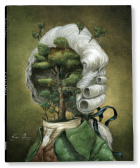
Vladimir Nabokov. Anniversary notes
My first intention was to write an elaborate paper on this
TriQuarterly number (17, Winter 1970, Northwestern
University, Evanston, Illinois) which is dedicated to me on the
occasion of my seventieth birthday. I soon realized, however,
that I might find myself discussing critical studies of my
fiction, something I have always avoided doing. True, a
festschrift is a very special and rare occasion for that kind
of sport, but I did not wish to create even the shadow of a
precedent and therefore decided simply to publish the rough
jottings I made as an objective reader anxious to eliminate
slight factual errors of which such a marvelous gift must be
free; for I knew what pains the editors, Charles Newman and
Alfred Appel, had taken to prepare it and remembered how firmly
the guest co-editor, when collecting the ingredients of this
great feast, refused to show me any plum or crumb before
publication.
BUTTERFLIES
Butterflies are among the most thoughtful and touching
contributions to this volume. The old-fashioned engraving of a
Catagramma-like insect is delightfully reproduced twelve
times so as to suggest a double series or "block" of specimens
in a cabinet case; and there is a beautiful photograph of a Red
Admirable (but "Nymphalidae" is the family to which it belongs,
not its genus, which is Vanessa-- my first bit of
carping).
ALFRED APPEL, JR.
Mr. Appel, guest co-editor, writes about my two main works
of fiction. His essay "Backgrounds of Lolita" is a
superb example of the rare case where art and erudition meet in
a shining ridge of specific information (the highest and to me
most acceptable function of literary criticism). I would have
liked to say more about his findings but modesty (a virtue that
the average reviewer especially appreciates in authors) denies
me that pleasure.
His other piece in this precious collection is "Ada
Described." I planted three blunders, meant to ridicule
mistranslations of Russian classics, in the first paragraph of
my Ada: the opening sentence of Anna Karenin (no
additional "a," printer, she was not a ballerina) is turned
inside out; Anna Arkadievna''s patronymic is given a grotesque
masculine ending; and the title of Tolstoy''s family chronicle
has been botched by the invented Stoner or Lower (I must have
received at least a dozen letters with clarifications and
corrections from indignant or puzzled readers, some of them of
Russian origin, who never read Ada beyond the first
page). Furthermore, in the same important paragraph, "Mount
Tabor" and "Pontius" allude respectively to the
transfigurations and betrayals to which great texts are
subjected by pretentious and ignorant versionists. The present
statement is an amplification of Mr. Appel''s remarks on the
subject in his brilliant essay "Ada Described." I
confess that his piece was a great pleasure to read, but one
error in it I really must correct: My Baltic Baron is totally
and emphatically unrelated to Mr. Norman Mailer, the writer.
SIMON KARLINSKY
Mr. Karlinsky''s "N. and Chekhov" is a very remarkable
essay, and I greatly appreciate being with A. P. in the same
boat-- on a Russian lake, at sunset, he fishing, I watching the
hawkmoths above the water. Mr. Karlinsky has put his finger on
a mysterious sensory cell. He is right, I do love Chekhov
dearly. I fail, however, to rationalize my feeling for him: I
can easily do so in regard to the greater artist, Tolstoy, with
the flash of this or that unforgettable passage (". . . how
sweetly she said: "and even very much'' "-- Vronsky recalling
Kitty''s reply to some trivial question that we shall never
know), but when I imagine Chekhov with the same detachment all
I can make out is a medley of dreadful prosaisms, ready-made
epithets, repetitions, doctors, unconvincing vamps, and so
forth; yet it is his works which I would take on a trip
to another planet.
In another article-- on "N.''s Russified Lewis Carroll"-the same critic is much too kind to my Anya in
Wonderland (1924). How much better I could have done it
fifteen years later! The only good bits are the poems and the
word-play. I find an odd blunder in the "Song of the Soup":
lohan''^ kind of bucket) is misspelt by me and twisted
into the wrong gender. Incidentally, I had not (and still have
not) seen any other Russian versions of the book (as Mr.
Karlinsky suggests I may have had) so that my sharing with
Poliksena Solovyov the same model for one of the parodies is a
coincidence. I recall with pleasure that one of the accidents
that prompted Wellesley College to engage me as lecturer in the
early forties was the presence of my rare Anya in the
Wellesley collection of Lewds Carroll editions.
ROBERT ALTER
Mr. Alter''s essay on the "Art of Politics in Invitation
to a Beheading" is a most brilliant reflection of that book
in a reader''s mind. It is practically flawless so that all I
can add is that I particularly appreciated his citing a passage
from The Gift "that could serve as a useful gloss on the
entire nature of political and social reality in the earlier
novel."
STANLEY EDGAR HYMAN
Mr. Hyman in his first-rate piece "The Handle" discusses
Invitation to a Beheading and Bend Sinister, the
two book-ends of grotesque design between which my other
volumes tightly huddle. I am a great admirer of Ransom''s poem
about Captain Carpenter aptly mentioned by Mr. Hyman.
DABNEY STUART
I must point out two fascinating little mistakes in Mr.
Stuart''s very interesting "Laughter in the Dark:
Dimensions of Parody": (1) The film in which my heroine is
given a small part in the 1920s has nothing to do with Garbo''s
Anna Karenina (of which incidentally I have only seen
stills); but what I would like my readers to brood over is my
singular power of prophecy, for the name of the leading lady
(Dorianna Karenina) in the picture invented by me in 1928
prefigured that of the actress (Anna Karina) who was to play
Margot forty years later in the film Laughter in the
Dark, and (2) Mr. Stuart cleverly toys with the idea that
Albert Albinus and Axel Rex are "doubles," one of his main
clues being that Margot finds Albinus'' telephone number not
under "A" but under "R" in the directory. Actually that "R" is
a mere slip or type (the initial corresponds correctly to the
man''s name in the first English-language edition of the novel,
London, 1936).
GEORGE STEINER
Mr. Steiner''s article ("Extraterritorial") is built on
solid abstractions and opaque generalizations. A few specific
items can be made out and should be corrected. He absurdly
overestimates Oscar Wilde''s mastery of French. It is human but
a little cheap on his part to chide my Van Veen for sneering at
my Lolita (which, in a transfigured form, I
magnanimously turned over to a transposed fellow author); it
might be wiser for him to read Ada more carefully than
did the morons whom he rightly condemns for having dismissed as
hermetic a writer''s limpid and precise prose. To one piece of
misinformation I must strongly object: I never belonged to the
"haute bourgeoisie" to which he grimly assigns me
(rather like that Marxist reviewer of my Speak, Memory
who classified my father as a "plutocrat" and a "man of
affairs"!). The Nabokovs have been soldiers and squires since
(at least) the fifteenth century.
BARBARA HELDT MONTER
In her otherwise impeccable little piece "Spring in
Fialta: The Choice that Mimics Chance," Mrs. Barbara Monter
makes a slight bibliographic mistake. She implies that I wrote
the Russian original of the story sometime around 1947, in
America. This is not so. It was written at least a dozen years
earlier, in Berlin, and was first published in Paris ("Vesna v
Fial''te," Sovremennyya Zapiski, 1936) long before being
collected in the Chekhov House edition, New York, 1956. The
English translation (by Peter Pertzov and me) appeared in
Harper''s Bazaar, May, 1947.
JEFFREY LEONARD
I am not sure that Mr. Leonard has quite understood what
Van Veen means by his "texture of time" in the penultimate part
of Ada. First of all, whatever I may have said in an old
interview, it is not the entire novel but only that one part
(as Alfred Appel correctly points out elsewhere) in which the
illustrative metaphors, all built around one viatic theme,
gradually accumulate, come to life, and form a story turning on
Van''s ride from the Grisons to the Valais-- after which the
thing again disintegrates and reverts to abstraction on a last
night of solitude in a hotel in Vaud. In other w''-ords, it is
all a structural trick: Van''s theory of time has no existence
beyond the fabric of one part of the novel Ada. In the
second place, Mr. Leonard has evidently not grasped what is
meant by "texture"; it is something quite different from what
Proust called "lost time," and it is ...
|
|
|
|
|
|
|
|
|


 Go to the beginning of the document
 Go to previous page
 Go to next page
 Go to the end of document